|
Snow
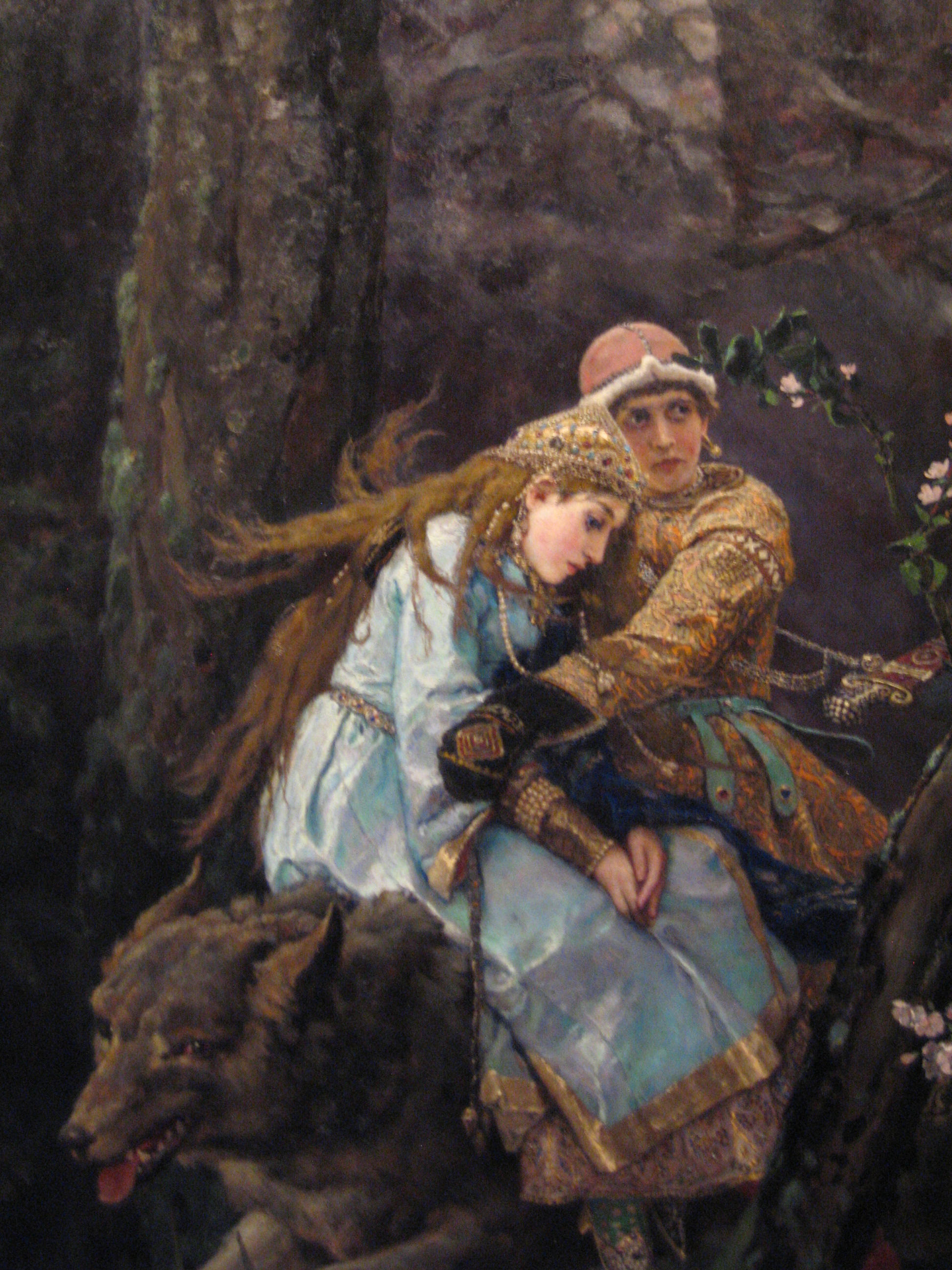
White and Rose Green
Once upon
a time there were two sisters and one got married and one didn't.
Or, once upon a time there were two piglets and one went to market and
one didn't, or, one was straight and one wasn't.
The point is, whatever they did or failed to do, they were a great
disappointment to their poor mother. Luckily for them, the two sisters
loved one another. When they saw that their mother was growing more and
more unhappy, they proposed to her that she cut them in half and out of
the two good halves make one splendid one. Their mother refused in high
indignation, but she was so wretched that the dutiful daughters went to
a surgeon. The surgeon obligingly sawed them in half, then interchanged
halves and stuck them together. But there were still two of them. This
was a problem. So they went back home and said to their mother, "Now
choose the good one." But their mother was furious that they had even
thought of such a scheme. "You did it to mock me," she told them angrily.
"You are both bad children." When the two sisters heard her say this,
the Good One wept, but the Bad One smirked.
Suniti
Namjoshi
From: From the Bedside Book of Nightmares, Fiddlehead,
Frederection, 1984
The Human
Condition / Stop the Train
The story
is told of a man who, being late for a trip, arrived at a railroad
station and jumped onto the first available train. Extenuated, he dozed
off for a while and then upon waking up, saw the train rumbling along at
full speed toward an unknown destination. He began querying everyone,
complaining aloud and finally crying and shouting. He demanded that the
train stop to let him off. The more excited he became, the more the
other passengers, eerily silent and sowncast, seemed puzzled by his
behavior. Finally a kind old man told him, "don't you know, this train
has only one destination, the ocean depths from which no one ever
returns." Once we are born, our final destination is death -- the deep
ocean. Why fret and fuss? All we can do is to use our time on earth to
develop the Bodhi-mind, seeking Enlightenment for ourselves and others
From
Thus Have I Heard, edited by Minh Thanh and P.D. Leigh

The Crow and the Pitcher
A crow perishing with thirst saw a pitcher, and hoping to find water,
flew to it with delight. When he reached it, he discovered to his grief
that it contained so little water that he could not possibly get at it.
He tried everything he could think of to reach the water, but all his
efforts were in vain. At last he collected as many stones as he could
carry and dropped them one by one with his beak into the pitcher, until
he brought the water within his reach and thus saved his life.
From Aesop Fables
A Tale of Two Wolves
One evening an old Cherokee woman told her grand daughter about a debate
that goes on inside people. She said, "My dear, the battle between two
wolves is inside us all. One is selfish and fearful. It is anger, envy,
jealousy, sorrow, regret, greed,
arrogance, desire, self-pity, guilt, resentment, inferiority, lies,
false pride, superiority, and ego.
The other is unselfish and without fear. It is peace, love, joy, hope,
serenity, humility, kindness, benevolence, empathy, generosity, truth,
compassion, and faith."
Her granddaughter thought about this for a minute and then asked: "Which
wolf wins?"
"The one you feed the most," her grandmother replied.
- - - - - - - - - - - - - - - - - - - -
T O P - - - - - - - - - - -
- - - - - - - - -
throwing
starfish
“Once upon a time, there was a wise man who used to
go to the ocean to do his writing. He had a habit of walking on the
beach before he began his work.
One day, as he was walking along the shore, he looked down the beach and
saw a human figure moving like a dancer. He smiled to himself at the
thought of someone who would dance to the day, and so, he walked faster
to catch up.
As he got closer, he noticed that the figure was that of a young man,
and that what he was doing was not dancing at all. The young man was
reaching down to the shore, picking up small objects, and throwing them
into the ocean.
He came closer still and called out "Good morning! May I ask what it is
that you are doing?"
The young man paused, looked up, and replied "Throwing starfish into the
ocean."
"I must ask, then, why are you throwing starfish into the ocean?" asked
the somewhat startled wise man.
To this, the young man replied, "The sun is up and the tide is going
out. If I don't throw them in, they'll die."
Upon hearing this, the wise man commented, "But, young man, do you not
realize that there are miles and miles of beach and there are starfish
all along every mile? You can't possibly make a difference!"
At this, the young man bent down, picked up yet another starfish, and
threw it into the ocean. As it met the water, he said,
"It made a difference for that one.”
Loren Eiseley

- - - - - - - - - - - - - - - - - - - -
T O P - - - - - - - - - - -
- - - - - - - - -
Milarepa's Last Testament
as told
by Lama Surya Das
After the
enlightened Cave-yogi and songmaster Milarepa left this world, a scrap
of rice paper was found inscribed with his handwriting. His ascetic
followers were astounded, for it stated that beneath a nearby boulder
was buried all the gold that ascetic Mila had hoarded during his life.
A few eager disciples dug around and under that large rock. In the earth
they discovered a ragged cloth bundle. Opening the knotted bundle with
shaking hands, they discovered only a lump of dried shit.
There was another scribbled note as well. It said: "If you understand my
teaching so little that you actually believed I ever valued or hoarded
gold, you are truly heirs to my shit."
The note was signed "The Laughing Vajra, Milarepa."
Similes
of
Ajahn Chah
Lumber
If you
don't bother to train your heart, then it remains wild, following the
ways of nature. It's possible to train that nature so that it can be
used to advantage. This is comparable to trees.
If we just left trees in their natural state, then we would never be
able to build a house with them. We couldn't make planks or anything of
use to build a house with. However, if a carpenter came along wanting to
build a house, he would go looking for trees in their natural state. He
would take raw material and use it to advantage. In a short time he
could have a house built.
Meditation and developing the heart are similar to this. You must take
this untrained heart as you would take a tree in its natural state in
the forest, and train this natural heart so that it is more refined,
more aware of itself, and more sensitive.
Crooked
tree
The
essence of our practice is to watch intention and examine the mind. You
must have wisdom. Don't discriminate. Don't get upset with others if
they are different. Would you get upset at a small and crooked tree in
the forest for not being tall and straight like some of the others? That
would be silly. Don't judge other people. There are all varieties. No
need to carry the burden of wishing to change them all. If you want to
change anything, change your ignorance to wisdom.
Mulian
In China
people believed in a purifying life in the hereafter, complete with
judges and warders, who could punish the dead for the sins they
committed during their life. A well-known example of this is about the
quest of Mulian, the disciple of the Buddha, who found his deceased
mother.
Mulian is
searching his mother. Therefore he has to descend through the porches of
the Yellow Wells, the residence of the dead, because his mother doesn't
live anymore. Mulian passes horrible purgatories. Finally he finds his
mother in the most deep hell, where her body is nailed down with 49 long
nails. The mother, who was sent to this hell because of sins she had
committed in former lives, is constantly hungry. The reason is, that her
neck grew so thin, that the food can't be swallowed. Besides, every time
when Mulian offers her food in the temple of the ancestors, flames light
it when the food arrives at his mother's mouth, so that she can't eat
it..
Mulian can't endure the suffering of his mother and begs for the
Buddha's help. The Buddha advices him to bring food offerings to the
hungry monks at the fifteenth day of the seventh month. When Mulian does
so, his mother is set free and she goes to heaven.
- - - - - - - - - - - - - - - - - - - -
T O P - - - - - - - - - - -
- - - - - - - - -
The life of the Buddha
Buddha was an Indian prince, who was born more than
2500 years ago on the slope of the Himalayas. During his youth, he was
surrounded by young and beautiful servants, and was living in three
luxurious palaces. He was well educated and prepared to be the King.
The young prince adventured outside his palaces when he grew up. He saw
some of the human sufferings such as aging, sickness and death. He also
came across a monk who appeared to be happy, peaceful and liberated, yet
free of material possessions.
His interest in finding ways to relieve the human sufferings grew
stronger and stronger. He eventually left his palaces and family.
He followed various sages and their practices for six
years in his search for ways to relieve human sufferings. Despite a lot
of progress, he was not able to find the ultimate truth.
He went into deep meditation underneath a big tree one day. He vowed not
to leave it until he found the Truth. And there he attained
enlightenment in early dawn one day.
After his enlightenment, he started to turn the
Dharma wheel, teaching the Four Noble Truths and Noble Eightfold path to
his followers.
The Buddha continued to teach the Noble Eightfold Path, the path to end
sufferings:
· Moral discipline through right speech, right action and right
livelihood.
· Mental calmness through right effort, right mindfulness and right
concentration.
· Supreme wisdom through right view and right thought.
The Buddha passed away after over 45 years of
teaching.
A feudal lord and Japanese cherry blossoms
There lived a feudal lord in the north
of Japan. He had his castle and had many Samurais serving for him. It
was in the beginning of spring. It was the top season for Japanese
cherry blossoms ( Sakura blossoms ). In fact, there were many cherry
trees around his castle, whose blossoms were in the full bloom.
One night, as it was a clear night, he got out of his castle and walked
around it.
A moon was clearly seen in the night sky, and tree blanches were bent
with bunches of cherry blossoms in full bloom. He was enjoying the nice
fragrance of the blossoms.
When he came to a pond, he found someone there. He looked carefully and
realized that she was a young woman. The woman was elegantly dancing
along the pond.
Her dance movement was so elegant and beautiful that he spontaneously
began to sing for her. The woman continued her dance in harmony of his
song.
When her dance came to an end, the feudal lord started to dance. Then,
the woman began to sing for him with a beautiful voice. When his dance
came to an end, she again started dancing. The feudal lord and the woman
danced alternately. As time passed, he realized that his heart had been
completely fascinated with the woman, her voice and her dance. He walked
up to her and extended his arms to hug her in his arms.
Then, the dawn came. He was at a loss what to do because there was no
one in front of him. The woman wasn’t there any more. He looked around
and noticed that cherry blossoms on a branch were smiling at him.
S.Y.


Dandelions
A man who took great pride in his lawn found himself with a large crop
of dandelions. He fried every method he knew to destroy them. Still they
plagued him. Finally he wrote the Department of Agriculture. He
enumerated all the t
hings
he had tried and closed his letter with the question: “What shall I
do now?”
In due course the reply came: “We suggest you learn to love them.”
[ I was proud of my lawn but I too was plagued with dandelions that
I kept fighting with every means in my power. So learning to love
them was no easy task. I began by talking .to them each day. Cordial.
Friendly. They maintained a sullen silence. They were smarting from
the war I had waged against them, and were suspicious of my motives.
But the day came when they smiled. And relaxed. And we started to be
friends. My lawn, of course, was ruined. But how attractive my
garden became! ]
The Song of the Bird
Just Two Words
There once was a monastery that was very strict. Following a vow of
silence, no one was allowed to speak at all. But there was one exception
to this rule. Every ten years, the monks were permitted to speak just
two words. Af
ter
spending his first ten years at the monastery, one monk went to the
head monk. "It has been ten years," said the head monk. "What are
the two words you would like to speak?"
"Bed... hard..." said the monk.
"I see," replied the head monk.
Ten years later, the monk returned to the head monk's office. "It
has been ten more years," said the head monk. "What are the two
words you would like to speak?"
"Food... stinks..." said the monk.
"I see," replied the head monk.
Yet another ten years passed and the monk once again met with the
head monk who asked, "What are your two words now, after these ten
years?"
"I... quit!" said the monk.
"Well, I can see why," replied the head monk. "All you ever do is
complain."
The
Soup of the Soup of the Duck
A relative came to visit Nasruddin bringing a duck as a gift. So the
bird was cooked and eaten. Soon a stream of guests began to call,
each claiming to be a friend of the friend of the ‘man who brought
you
the duck.’ Each one, of course, expected to be fed and housed on
the strength of that hapless bird. The Mulla bore it manfully
till the day a stranger arrived and said: “I am a friend of the
friend of the kinsman who brought you the duck.” And, like the
others, he sat down, expecting to be fed. Nasruddin placed a
bowl of steaming water under his nose. “What’s this?” asked the
stranger. “This,” said the Mulla “is the soup of the soup of the
duck that was brought me by your friend.”
[ One hears of people who became the disciples of someone who
experienced the Divine.
How can you transmit a kiss through a messenger? ]
The Song of the Bird
We'll See
There is a Taoist story of an old farmer who had worked his
crops for many years. One day his horse ran away. Upon hearing
the news, his neighbors came to visit.
"Such bad luck," they said sympathetically.
"We'll see," the farmer replied.
The next morning the horse returned, bringing with it three
other wild horses.
"How wonderful," the neighbors exclaimed.
"We'll see," replied the old man.
The following day, his son tried to ride one of the untamed
horses, was thrown, and broke his leg. The neighbors again came
to offer their sympathy on his misfortune.
"We'll see," answered the farmer.
The day after, military officials came to the village to draft
young men into the army. Seeing that the son's leg was broken,
they passed him by. The neighbors congratulated the farmer on
how well things had turned out.
"We'll see" said the farmer.
|
Crooked
tree
The Crow and the Pitcher
Dandelions
A feudal lord and Japanese cherry blossoms
Just two Words
The Life of the Buddha
Milarepa's Last Testament
Mulian
Similes of Ajahn Chah
Snow White and Rose Green
Stop the
train
The
Soup of the Soup of the Duck
A
Tale of Two Wolves
Throwing Starfish
We'll see |

 Dutch
Dutch