Cedar Gallery
Home
|
Cedar info |
News |
Contact |
 Dutch
Dutch

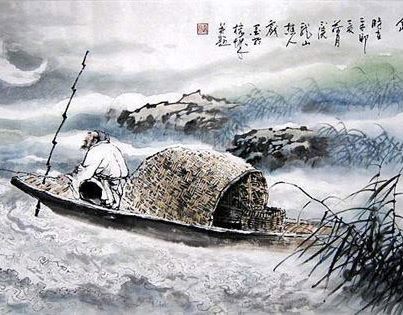
Living in this world -
to what shall I compare it?
Its like a boat
rowing out at break of day,
leaving no trace behind.
Sami Mansei
Religion
Religious life in Japan is rich and varied, with a long history of
interaction among a number of religious traditions, including Shinto,
Buddhism, Confucianism, an Christianity.
Article 20 of the Constitution of Japan states that freedom of religion
is guaranteed to all.
The worship of kami, the Shinto gods, slowly emerged at
the dawn of Japanese history and crystallized as an imperial religious
system beginning in the Nara period (710-794). The only major religion
indigenous to Japan, Shinto can be seen both as a loosely structured set
of practices and attitudes rooted in local communities and as a strictly
defined and organized religion at the level of the imperial line and the
state. After the Meiji Restoration of 1868 Shinto became the state
religion, but it lost this official status after World War II. Many
local Shinto shrines hold annual festivals, and customs such as visiting
a shrine (or Buddhist temple) on New Year's Day and taking newborn
babies to the local shrine are still observed across Japan.
Buddhism was introduced from Korea in the mid-6th century and spread
quickly among the ruling aristocracy.
Prince Shotoku Taishi, Imperial Regent to Empress
Suiko, was a young man with a strong sense of national identity. In an
apparent attempt to build a society modeled after the Chinese system, he
created the first major treatise on political theory in Japanese
history: the Seventeen Article Constitution.
Written in Chinese in 604 AD, Prince Shotoku's ‘constitution’ was
strongly based on both Confucian and Buddhist principles. Shinto is
never mentioned.
The most important and universal feature of this document is its
emphasis on harmony. This concept, derived from Confucianism, is one of
the most enduring and most repeated principles in Japanese culture and
history. Even today it is an integral part of Japanese business and
politics.Prince Shotoku gave imperial support to the building of
major temples, including Horyuji in present-day Nara Prefecture.
Zen Buddhism, which came to be favored by the dominant military
class, arrived from China in the 12th century, and around the same time
popular sects such as the Pure Land sect also emerged. Today Buddhism is
divided into 13 principal sects maintaining about 80,000 temples.
Buddhist rites are used in about 90 percent of the funerals held in
Japan.
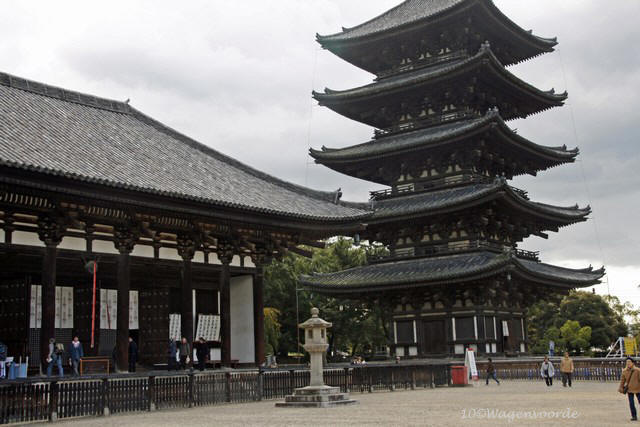
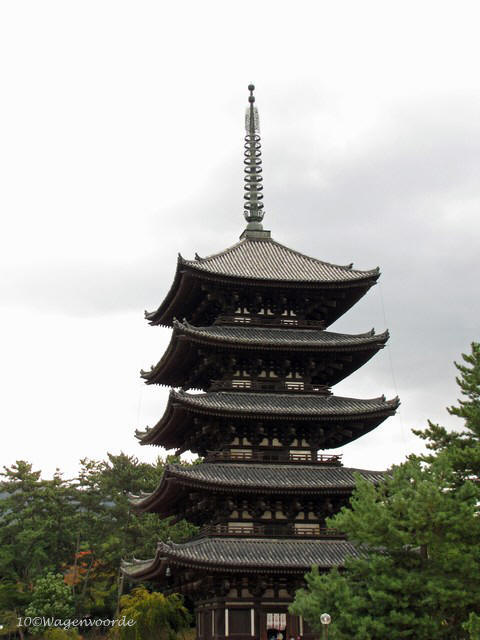
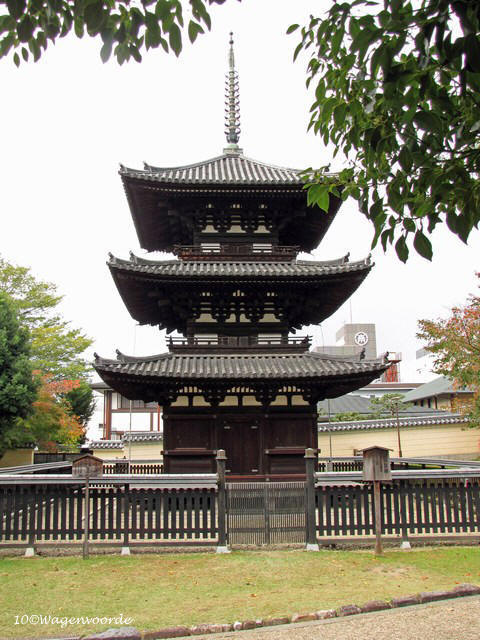
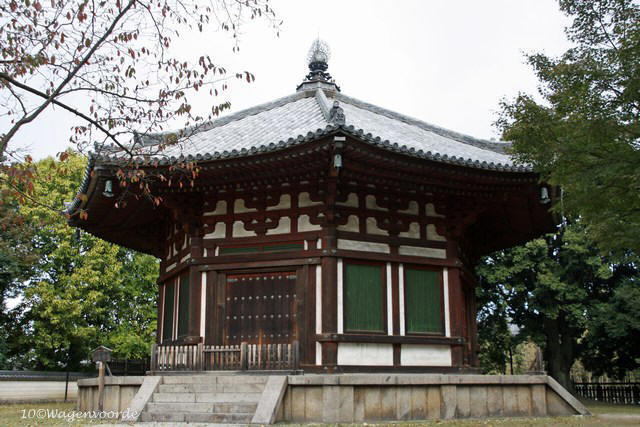
The four pictures above are of The Kofuku-ji
Temple Complex
The traditional entrance to temples in Japan is from the south.
Although, the Nandaimon (Great Southern Gate) of Kofuku-ji no longer
exisits, you will know that you are close to the ancient entrance when
you are near the five story Pagoda that dominates the complex.
Kofuku-ji temple was one of Japan's great temples in the eighth century.
It was founded in 669 by a member of the Fujiwara clan to pray for the
clan leader to recover from illness. It was originally built in Kyoto,
but was moved to its present location when Nara became the capital in
the year 710. For a while it prospered, but when the Fujiwaras' power
began to fade in the twelfth century, the temple lost its influential
patrons. Now only a few buildings remain of the original 175 buildings
from that period. During its prosperity, it was one of the "Four Great
Temples" of the Nara period (710-794).
In the Nara period, the pagoda was the most important structure in the
temple complex as it held the relics (such as a bone or tooth) of a
Buddha. There are two pagodas in the Kofuku-ji complex. They are located
on either side of the site of the Great Southern Gate; the Three Storied
Pagoda to the west and the Five Storied Pagoda to the east. The Goju-no-to
(Five Storied Pagoda) was built in 725 by the Empress Komyoh, and the
current structure was restored in 1426. It is one of the symbols of Nara
and is the second highest pagoda in Japan with a height of 50.1 meters.
Three Storied Pagogoda was built in 1143 by Emporer Shotoku. The present
building is also a reconstruction from the beginning of the Kamakura
period(1185-1333). This pagoda holds four paintings on wood which depict
1000 images of each of the same Buddhas enshrined in the Five Storied
Pagoda .
Confucianism is the way of life propagated by
Confucius in the 6th–5th century BCE, and followed by the
Chinese people for more than two
millennia. Although transformed over time, it is still the substance of
learning, the source of values, and the social code of the Chinese. Its
influence has also extended to Japan (and other countries, particularly
Korea and Vietnam). Confucianism, a Western term that has no counterpart
in Chinese, is a worldview, a social ethic, a political ideology, a
scholarly tradition, and a way of life. Sometimes viewed as a philosophy
and sometimes as a religion, Confucianism may be understood as an
all-encompassing way of thinking and living that entails ancestor
reverence and a profound human-centred religiousness. East Asians may
profess themselves to be Shintōists, Daoists, Buddhists, Muslims, or
Christians, but, by announcing their religious affiliations, seldom do
they cease to be Confucians. Although often grouped with the major
historical religions, Confucianism differs from them by not being an
organized religion. Therefore people do not always call it 'religion'.
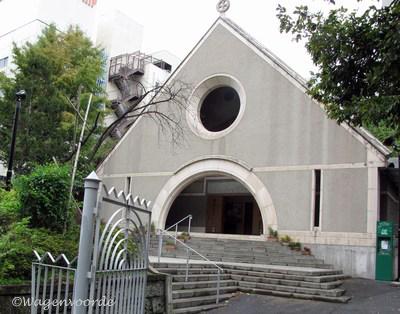
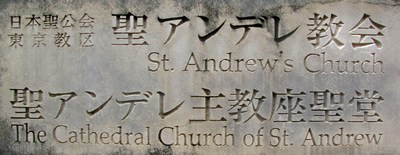
Tokyo 2010
Jesuit missionaries brought Christianity to Japan in the mid-16th
century, but in the next century the Tokugawa government proscribed the
religion and expelled all missionaries. Christianity was reintroduced
into Japan in the Meiji period (1868-1912).
In the 20th century a large number of new religions have
developed, with some attracting huge numbers of followers. The teachings
of these religions are in many cases primarily Buddhist or Shinto in
origin, but elements of Confucianism, Taoism, and shamanism are also
sometimes present.
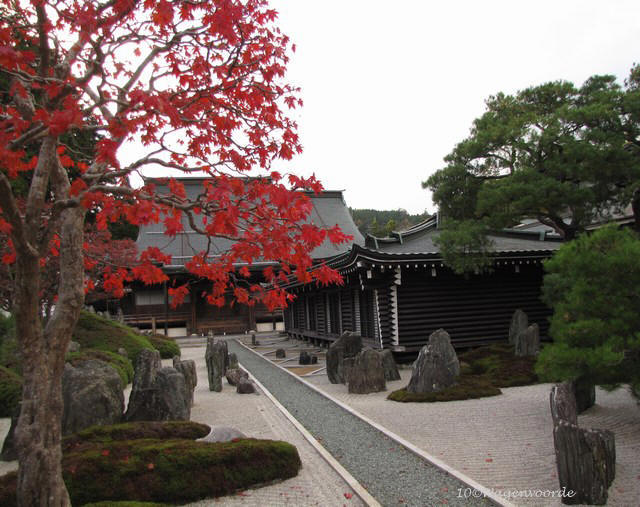
Shinto
Shinto is an ancient Japanese religion. It started
about 500 BC (or earlier) and derived its name from the Chinese words
"shin tao" ("The Way of the Gods") in the 8th century . At that time
Shinto established itself as an official religion of Japan, along with
Buddhism.
Unlike most other religions, Shinto has no real founder, no written
scriptures and a very loosely-organized priesthood.
Shinto creation stories tell of the history and lives of the "Kami"
(deities). Among them was a divine couple, Izanagi-no-mikoto and
Izanami-no-mikoto, who gave birth to the Japanese islands. Their
children became the deities of the various Japanese clans. Amaterasu
Omikami (Sun Goddess) was one of their daughters. She is the ancestress
of the Imperial Family and is regarded as the chief deity. Her shrine is
at Ise. Her descendants unified the country.
The Kami are the Shinto deities. However, the Kami bear little
resemblance to the gods of monotheistic religions. There are no
concepts like the wrath of God, his omnipotence and omni-presence, or
the separation of God from humanity due to sin.
Some deities belong to a certain place, while others are linked to
natural phenomenons or things, for example food, rivers or rocks.
They are seen as generally benign; they sustain and protect the people.
About 84% of the population of Japan follow two religions: both Shinto
and Buddhism. Buddhism first arrived in Japan from Korea and China
during the 6th through 8th centuries. The two religions share a basic
optimism about human nature, and for the world. Within Shinto, the
Buddha was viewed as another "Kami". Meanwhile, Buddhism in Japan
regarded the Kami as being manifestations of various Buddhas and
Bodhisattvas. Most weddings are performed by Shinto priests; funerals
are performed by Buddhist priests.
Some other details.
Ancestors are worshipped. All of humanity is regarded as "Kami's child."
Thus all human life is sacred. Believers revere "musuhi", the Kamis'
creative and harmonizing powers. They aspire to have "makoto", sincerity
or true heart. This is regarded as the way or will of Kami.
Morality is based upon that which is of benefit to the group.
Nature is sacred; to be in contact with nature is to be close to the
Gods. Natural objects are worshipped as sacred spirits.
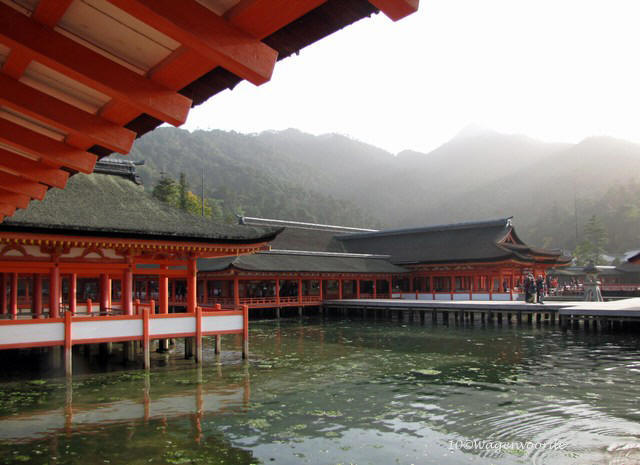
Shinto recognizes many sacred places: mountains, springs, etc.
Each shrine is dedicated to a specific Kami who has a divine personality
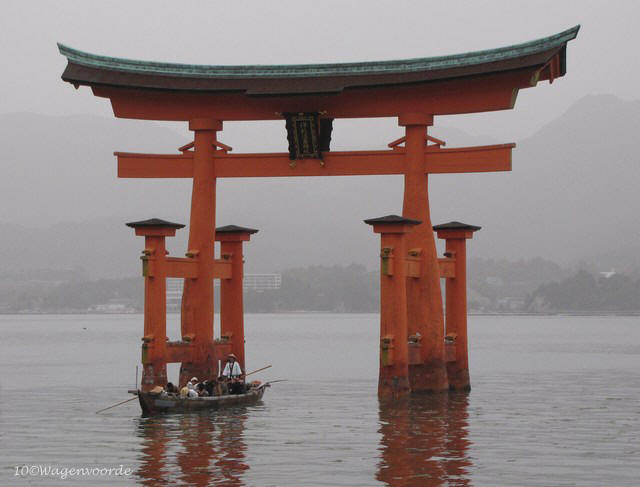
and responds to sincere prayers of the faithful. When entering a shrine,
one passes through a Tori a special gateway for the Gods. It marks the
demarcation between the finite world and the infinite world of the Gods.
An altar, the "Kami-dana" (Shelf of Gods), is given a central place in
many homes.
Origami ("Paper of the spirits") is a Japanese folk art in which paper is folded into beautiful shapes. They are often seen around Shinto shrines. Out of respect for the tree spirit that gave its life to make the paper, origami paper is never cut.
Shinto is a tolerant religion which accepts the validity of other religions. It is common for a believer to pay respects to other religions, their practices and objects of worship.
to be continued ...
ZEN, an inspiring film about Dogen, the founder of
Zen Buddhism
in Japan.
Pictures and story, click
HERE.
Sources/adviced literature
Religion in Contemporary Japan - Ian Reader
Introducing Japanese Religion - Robert Ellwood
Sources of Japanese Tradition - Wm. Theodore de de Bary
The Japan Book - ISBN978-4-7700-2847-1
Zen Mind, Beginner's Mind - Shunryu Suzuki
On Understanding Japanese Religion - Joseph Mitsuo Kitagawa
Japanese Religion and Society - Winston Davis
A History of Japanese Religion - Kazuo Kasahara
Texts, pictures,
etc. are the property of their respective owners.
Cedar Gallery is a non-profit site. All works and articles are published
on this site purely for educational reasons, for the purpose of
information and with good intentions. If the legal representatives ask
us to remove a text or picture from the site, this will be done
immediately. We guarantee to fulfill such demands within 72 hours.
(Cedar Gallery reserves the right to investigate whether the person
submitting that demand is authorized to do so or not).
The contents of this website (texts, pictures and other material) are protected by copyright. You are welcome to visit the site and enjoy it. But no part of this website may be reproduced in any form by any means without prior written permission. If you like to use a picture or text, first send your request to
